Sunday, April 29, 2018

Pericarditis

Pericarditis is a condition in which the sac-like covering around the heart (pericardium) becomes inflamed.
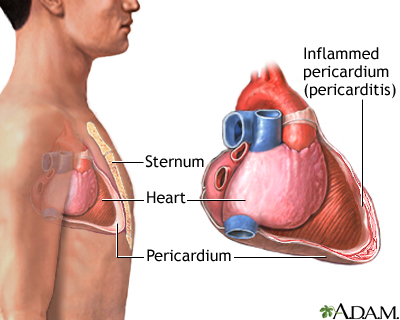
Pericarditis is a disorder caused by inflammation of the pericardium, the sac-like covering of the heart. Pericarditis can be caused by bacterial, fungal, or viral infections. It may also be a result of injury or trauma to the chest, esophagus, or heart. Pain occurs as a result of the inflamed pericardium rubbing against the heart.

Causes

The cause of pericarditis is unknown or unproven in many cases. It mostly affects men ages 20 to 50 years.
Pericarditis is often the result of an infection such as:
  • Viral infections that cause a chest cold or pneumonia
  • Infections with bacteria (less common)
  • Some fungal infections (rare)
The condition may be seen with diseases such as:
Other causes include:
  • Heart attack
  • Heart surgery or trauma to the chest, esophagus, or heart
  • Certain medicines, such as procainamide, hydralazine, phenytoin, isoniazid, and some drugs used to treat cancer or suppress the immune system
  • Swelling or inflammation of the heart muscle
  • Radiation therapy to the chest

Symptoms

Chest pain is almost always present. The pain:
  • May be felt in the neck, shoulder, back, or abdomen
  • Often increases with deep breathing and lying flat, and may increase with coughing and swallowing
  • Can feel sharp and stabbing
  • Is often relieved by sitting up and leaning or bending forward
You may have fever, chills, or sweating if the condition is caused by an infection.
Other symptoms may include:

Exams and Tests

When listening to the heart with a stethoscope, the health care provider can hear a sound called a pericardial rub. The heart sounds may be muffled or distant. There may be other signs of excess fluid in the pericardium (pericardial effusion).
If the disorder is severe, there may be:
  • Crackles in the lungs
  • Decreased breath sounds
  • Other signs of fluid in the space around the lungs
The following imaging tests may be done to check the heart and the tissue layer around it (pericardium):
To look for heart muscle damage, the provider may order a troponin I test. Other laboratory tests may include:

Treatment

The cause of pericarditis should be identified, if possible.
High doses of nonsteroidal anti-inflammatory drugs (NSAIDs) such as ibuprofen are often given with a medicine called colchicine. These medicines will decrease your pain and reduce the swelling or inflammation in the sac around your heart.
If the cause of pericarditis is an infection:
  • Antibiotics will be used for bacterial infections
  • Antifungal medicines will be used for fungal pericarditis
Other medicines that may be used are:
  • Corticosteroids such as prednisone (in some people)
  • "Water pills" (diuretics) to remove excess fluid
If the buildup of fluid makes the heart function poorly, treatment may include:
  • Draining the fluid from the sac. This procedure, called pericardiocentesis, may be done using an echocardiography-guided needle.
  • Cutting a small hole (window) in the pericardium (subxiphoid pericardiotomy) to allow the infected fluid to drain into the abdominal cavity
Surgery called pericardiectomy may be needed if the pericarditis is long-lasting, comes back after treatment, or causes scarring or tightening of the tissue around the heart. The operation involves cutting or removing part of the pericardium.

Outlook (Prognosis)

Pericarditis can range from mild illness that gets better on its own, to a life-threatening condition. Fluid buildup around the heart and poor heart function can complicate the disorder.
The outcome is good if pericarditis is treated right away. Most people recover in 2 weeks to 3 months. However, pericarditis may come back. This is called recurrent, or chronic, if symptoms or episodes continue.
Scarring and thickening of the sac-like covering and the heart muscle may occur when the problem is severe. This is called constrictive pericarditis. It can cause long-term problems similar to those of heart failure.

When to Contact a Medical Professional

Call your provider if you have symptoms of pericarditis. This disorder is not life threatening most of the time. However, it can be very dangerous if not treated.

Cardiac tamponade

Cardiac tamponade is pressure on the heart that occurs when blood or fluid builds up in the space between the heart muscle and the outer covering sac of the heart.

Causes

In this condition, blood or fluid collects in the sac surrounding the heart. This prevents the heart ventricles from expanding fully. The excess pressure from the fluid prevents the heart from working properly. As a result, the body does not get enough blood.
Cardiac tamponade can occur due to:
Other possible causes include:
Cardiac tamponade due to disease occurs in about 2 out of 10,000 people.

Symptoms

Symptoms may include:
  • Anxiety, restlessness
  • Sharp chest pain that is felt in the neck, shoulder, back, or abdomen
  • Chest pain that gets worse with deep breathing or coughing
  • Problems breathing
  • Discomfort, sometimes relieved by sitting upright or leaning forward
  • Fainting, lightheadedness
  • Pale, gray, or blue skin
  • Palpitations
  • Rapid breathing
  • Swelling of the legs or abdomen
  • Jaundice
Other symptoms that may occur with this disorder:
  • Dizziness
  • Drowsiness
  • Weak or absent pulse

Exams and Tests

Echocardiogram is the test of choice to help make the diagnosis. This test may be done at the bedside in emergency cases.
A physical exam may show:
  • Blood pressure that falls when breathing deeply
  • Rapid breathing
  • Heart rate over 100 (normal is 60 to 100 beats per minute)
  • Heart sounds are only faintly heard through a stethoscope
  • Neck veins that may be bulging (distended) but the blood pressure is low
  • Weak or absent peripheral pulses
Other tests may include:

Treatment

Cardiac tamponade is an emergency condition that needs to be treated in the hospital.
The fluid around the heart must be drained as quickly as possible. A procedure that uses a needle to remove fluid from the tissue that surrounds the heart will be done.
A surgical procedure to cut and remove part of the covering of the heart (pericardium) may also be done. This is known as surgical pericardiectomy or pericardial window.
Fluids are given to keep blood pressure normal until the fluid can be drained from around the heart. Medicines that increase blood pressure may also help keep the person alive until the fluid is drained.
Oxygen may be given to help reduce the workload on the heart by decreasing tissue demands for blood flow.
The cause of tamponade must be found and treated.

Outlook (Prognosis)

Death due to cardiac tamponade can occur quickly if the fluid or blood is not removed promptly from the pericardium.
The outcome is often good if the condition is treated promptly. However, tamponade may come back.

Possible Complications

Complications may include:

When to Contact a Medical Professional

Go to the emergency room or call the local emergency number (such as 911) if symptoms develop. Cardiac tamponade is an emergency condition that needs immediate medical attention.

Prevention

Many cases can't be prevented. Knowing your personal risk factors may help you get early diagnosis and treatment.


Alternative Names

Tamponade; Pericardial tamponade; Pericarditis - tamponade

Carcinoid syndrome

Carcinoid syndrome is a group of symptoms associated with carcinoid tumors. These are tumors of the small intestine, colon, appendix, and bronchial tubes in the lungs.

Causes

Carcinoid syndrome is the pattern of symptoms sometimes seen in people with carcinoid tumors. These tumors are rare, and often slow growing. Most carcinoid tumors are found in the gastrointestinal tract and lungs.
Carcinoid syndrome occurs in very few people with carcinoid tumors, after the tumor has spread to the liver or lung.
These tumors release too much of the hormone serotonin, as well as several other chemicals. The hormones cause the blood vessels to open (dilate). This causes carcinoid syndrome.

Symptoms

The carcinoid syndrome is made up of of four main symptoms including:
  • Flushing (face, neck, or upper chest), such as widened blood vessels seen on the skin (telangiectasias)
  • Difficulty breathing, such as wheezing
  • Diarrhea
  • Heart problems, such as leaking heart valves, slow heartbeat, low or high blood pressure
Sometimes symptoms are brought on by physical exertion, or eating or drinking things such as blue cheese, chocolate, or red wine.

Exams and Tests

Most of these tumors are found when tests or procedures are done for other reasons, such as during abdominal surgery.
If a physical exam is done, the health care provider may find signs of: 
  • Heart valve problems, such as murmur
  • Niacin-deficiency disease (pellagra)
Tests that may be done include:
  • 5-HIAA levels in urine
  • Blood tests (including serotonin and chromogranin blood test)
  • CT and MRI scan of the chest or abdomen
  • Echocardiogram
  • Octreotide radiolabeled scan

Treatment

Surgery to remove the tumor is usually the first treatment. It can permanently cure the condition if the tumor is completely removed.
If the tumor has spread to the liver, treatment involves transplantation of liver.
When the entire tumor cannot be removed, removing large portions of the tumor ("debulking") can help relieve the symptoms.
Octreotide (Sandostatin) or lanreotide (Somatuline) injections are given to people with advanced carcinoid tumors that cannot be removed with surgery.
People with carcinoid syndrome should avoid alcohol, large meals, and foods high in tyramine (aged cheeses, avocado, many processed foods), because they may trigger symptoms.
Some common medicines, like selective serotonin reuptake inhibitors (SSRIs), such as paroxetine (Paxil) and fluoxetine (Prozac), may make symptoms worse by increasing levels of serotonin. However, DO NOT stop taking these medicines unless your provider tells you to do so.

Support Groups

Learn more about carcinoid syndrome and get support from:

Outlook (Prognosis)

The outlook in people with carcinoid syndrome is sometimes different from the outlook in people who have carcinoid tumors without the syndrome.
Prognosis also depends on the site of tumor. In people with the syndrome, the tumor has usually spread to the liver. This lowers the survival rate. People with carcinoid syndrome are also more likely to have a separate cancer (second primary tumor) at the same time.
The outlook is more favorable thanks to new treatment methods.

Possible Complications

Complications of carcinoid syndrome may include:
A fatal form of carcinoid syndrome, carcinoid crisis may occur as a side effect of surgery, anesthesia or chemotherapy.

When to Contact a Medical Professional

Call for an appointment with your provider if you have symptoms of carcinoid syndrome.

Prevention

Treating the tumor reduces the risk of carcinoid syndrome.

Alternative Names

Flush syndrome; Argentaffinoma syndrome